
Macro Cycle
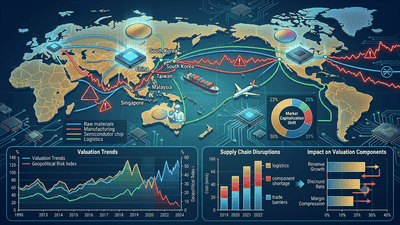
A Quantitative Model for Geopolitical Risk Premium in Semi Valuations
Geopolitics has moved from background noise to a central driver of semiconductor valuations. Export controls, regional subsidy races, onshoring mandates, and cross‑border M&A scrutiny all alter cash‑flow expectations and capital‑allocation decisions in ways traditional models often treat qualitatively, if at all.

Semi Equipment Procurement Lead Times Extended to 12 Months
In semiconductor manufacturing, time is as critical a resource as capital. When lead times for key tools stretch from a few months to a full year, the ripple effects can reshape fab build schedules, technology roadmaps, and industry supply dynamics. The extension of equipment procurement lead times toward the 12‑month mark is more than an operational inconvenience;

Analyzing the Distortion Effect of Government Subsidies on Semi FCF
Government subsidies have become a central feature of the modern semiconductor landscape. From grants and tax credits to low‑cost loans and direct equity participation, public programs now influence where fabs are built, how capacity is expanded, and which companies lead in critical technologies. On the surface, these subsidies often look like free or cheap money that improves investment economics.

2026 Global Semi CapEx Map: The Divergence Between Advanced and Mature Nodes
The semiconductor industry entered 2026 with a clearer, more bifurcated capital expenditure landscape than at any point in the past decade. As hyperscalers and AI-driven computing demands continue to escalate, foundries and integrated device manufacturers (IDMs) prioritize advanced-node capacity (3 nm, 2 nm and next-generation gate-all-around architectures).

Global Semi M&A Value Hits 5-Year High, Consolidation Wave Accelerates
When global semiconductor M&A value hits a five‑year high, it is more than a headline about deal flow—it is a structural signal. Rising transaction values and a thick pipeline of strategic deals tell us that industry leaders believe scale, integration, and portfolio breadth are increasingly essential in a market shaped by AI, automotive electrification, industrial automation, and geopolitical tension. The current consolidation wave is not the first the sector has seen, but it is distinct in scope and motivation.

The Unexpected Correlation Between Semi Sentiment and Crypto Mining Demand
Semiconductors and cryptocurrencies might seem like inhabitants of different worlds: one, a physical industry of fabs, wafers, and equipment; the other, a digital realm of tokens, blockchains, and speculative cycles. Yet over the past decade, an unexpected correlation has emerged between sentiment in the semiconductor sector and demand from crypto mining. When miners are euphoric and building out capacity, semi sentiment often improves;

SE Asia’s Share of Global OSAT Capacity Breaks 20% for the First Time
Outsourced Semiconductor Assembly and Test (OSAT) has long been the quiet backbone of the chip industry, turning bare wafers into usable, reliable packaged devices. For decades, much of the attention has focused on front‑end fabrication hubs in the US, Europe, Taiwan, Korea, and increasingly China.

Regional Reconfiguration of Global Semi Supply Chain: US-EU-SEA Triangle
The global semiconductor supply chain is undergoing a profound regional restructuring. Instead of a largely Asia‑centric manufacturing network feeding design and demand hubs elsewhere, the industry is evolving into a more segmented, multi‑pole system anchored by three increasingly distinct regions: the United States, the European Union, and Southeast Asia (SEA).

2H 2026 Semi Order Visibility Survey: Views from 50 Procurement Managers
As the semiconductor industry enters the second half of 2026, procurement teams find themselves in a markedly different environment than the one that defined the past three years. Shortages and emergency allocation have receded, inventories have largely normalized, and new regional capacity is ramping under various industrial policy programs.
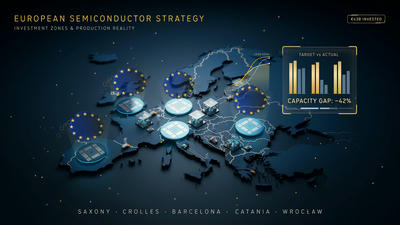
Europe’s Chips Act Catch-Up Dilemma: The Gap Between Capacity Targets and Reality
Europe’s Chips Act was launched with a bold ambition: to roughly double the continent’s share of global semiconductor production and secure strategic autonomy in a technology that underpins everything from cars and industrial equipment to cloud computing and defense systems. Policymakers framed it as a catch‑up mechanism—Europe would move from dependence on foreign fabs toward a more balanced, resilient ecosystem.